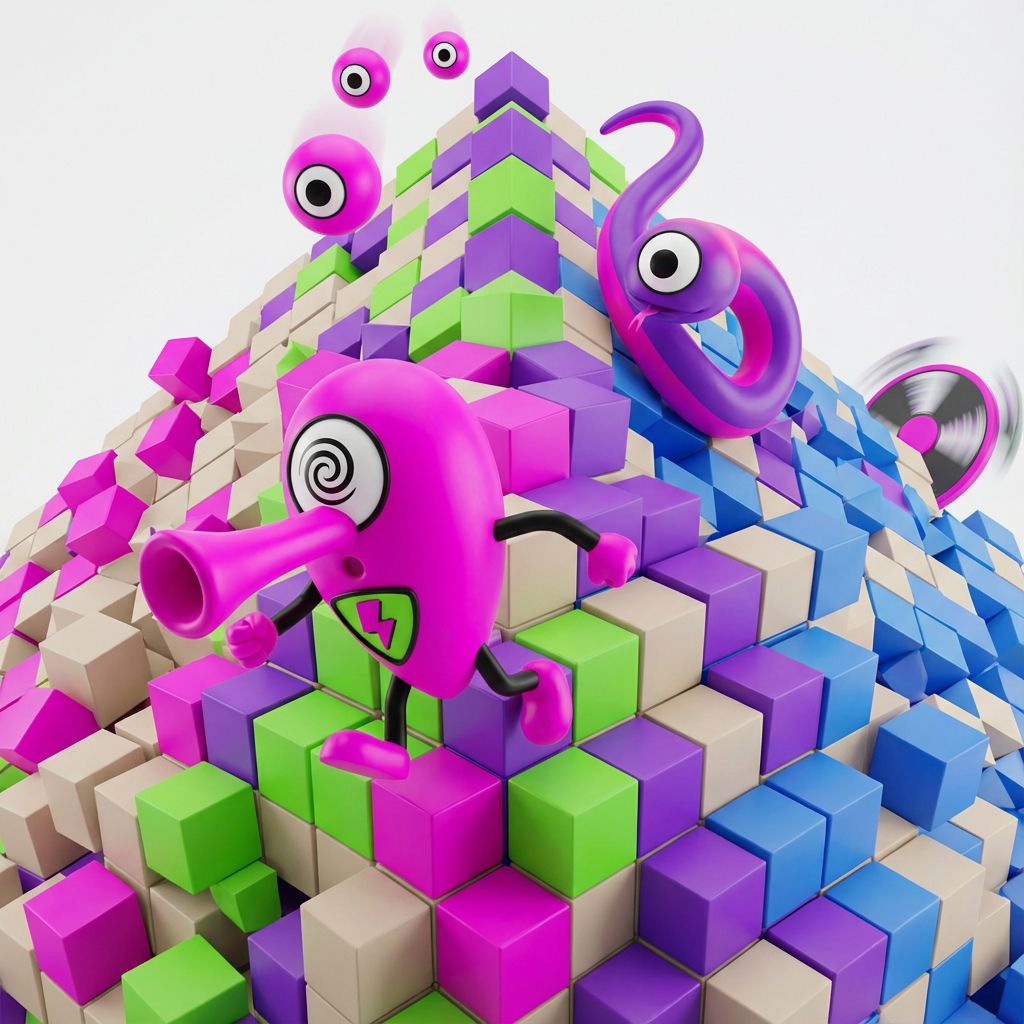
Picture this: it's 1982, and a bizarre orange creature with a tubular snout is hopping around a pyramid of cubes, swearing in cartoon symbols whenever he falls off. That's Q*bert, and despite sounding like a fever dream, it became one of the most beloved arcade games ever made.
The game's creator, Warren Davis, actually stumbled onto Q*bert by accident. He was originally developing a shooting game where players controlled a character firing at enemies on a pyramid. But when he showed it to his colleague Jeff Lee, they started brainstorming what would happen if the character changed the color of the tiles instead. That simple "what if" moment gave birth to an entirely new gameplay concept. The name itself? It came from "Cubes" (which would've been a terrible name) combined with the nonsensical "Hubert," eventually morphing into Q*bert with that iconic asterisk.
Here's something wild: Q*bert was one of the first games to give its character a personality beyond just being a player avatar. When Q*bert gets caught by the purple snake Coily or falls off the pyramid, he doesn't just die quietly—he curses. Well, sort of. The sound designers created a gibberish profanity using pulled samples played backwards, which made it past arcade operators but still conveyed Q*bert's frustration perfectly. Kids loved it, and it gave the little guy more character than most protagonists of the era. The speech bubble that pops up showing "@!#?@!" became so iconic that it's now gaming shorthand for cartoon swearing.
The game's success was absolutely massive. Q*bert merchandise flooded the market, from plush toys to a Saturday morning cartoon, making him nearly as recognizable as Pac-Man. He even appeared on the cover of Time Magazine in 1983 as part of their video game feature. But here's a lesser-known fact: the game's isometric perspective was revolutionary for its time, creating a pseudo-3D effect that influenced countless games afterward. Designers had to hand-code the unique diagonal movement since game engines didn't naturally support that kind of perspective.
Today, Q*bert holds up surprisingly well. That simple concept—hop on cubes, change their colors, avoid enemies—created layers of strategy that still challenge players. And that annoying little guy who swears when he messes up? He became gaming's first true personality, proving that characters didn't need to save princesses or fight aliens to win our hearts. Sometimes they just needed to hop around and curse creatively.
9,219 m²